

Lab-Grown vs. Natural Diamonds: A Guide to Choosing Your Stone
Because we believe in complete transparency, we want you to have all the information you need before choosing a diamond. This guide breaks down how both options compare so you can make an honest choice that fits your perspective, budget, and style.
What Is the Difference Between a Lab-Grown and a Natural Diamond?
The fundamental difference between the two comes down to origin. A natural diamond crystallizes deep underground over one to three billion years, while a lab-grown diamond is created in a controlled facility in a matter of weeks. Both are pure crystallized carbon, and by every scientific measure, both are real diamonds.
Because the two are chemically identical and visually indistinguishable to the naked eye, the choice really does come down to what feels right to you rather than any difference you can see in the finished stone. Even a trained gemologist needs specialized equipment to tell them apart.
HPHT
High Pressure, High Temperature. Recreates the intense heat and pressure conditions found deep underground, mimicking how natural diamonds form over billions of years.
CVD
Chemical Vapor Deposition. Grows the diamond crystal from a carbon-rich gas in a controlled facility. The growth method is noted on the stone's certificate.
The 4Cs: How Both Types Are Judged
The 4Cs, established by the Gemological Institute of America, are the universal language for diamond quality.
Cut
Cut has the single biggest impact on how a diamond looks. It refers to how well the facets are proportioned and polished, not the shape. A precise cut produces a diamond's sparkle, which is broken into brilliance (the white light reflected), fire (the flashes of rainbow color), and scintillation (the play of light and dark as the stone moves).
Color
Color grades how little color a diamond shows, running from D (colorless) down toward Z (light yellow or brown). For lab-grown diamonds, most stones now fall in the top colorless range.
Clarity
Clarity measures the tiny internal features, called inclusions, and surface marks, called blemishes. Most diamonds sold sit between VS (very slightly included) and SI (slightly included), and these are typically invisible to the naked eye.
Carat
Carat is weight, not size, though the two are related. Because natural diamonds are rarer in larger sizes, their price rises sharply with carat weight, while lab-grown prices scale much more gently.

Diamond Shapes: The Options in Our Stone Drawers
Both lab-grown and natural diamonds are available in every popular shape. Shape is a personal style choice and does not affect whether a stone is real. During a private design consultation, you can explore these shapes side by side at the counter:
- Round: The classic, and the most brilliant, thanks to its 57 or 58 facets.
- Oval: An elongating cut that is currently one of the most requested shapes.
- Cushion: Soft, pillow-like corners with a romantic, vintage feel.
- Emerald: A stepped, open cut prized for clarity and clean lines.
- Princess: A sharp, square, modern brilliant.
- Pear: A teardrop shape that flatters the finger.
- Radiant: A rectangular cut with brilliant-style faceting.
- Marquise: A long, pointed oval that looks large for its weight.
- Asscher: A squarer step cut with striking geometric depth.
- Heart: A romantic, symbolic favorite.
Fancy shapes – anything other than round – often cost less per carat and can make a stone look larger on the hand, which is worth knowing whichever origin you choose..
Certification and Grading: Reading the Report
We advise you to never buy a meaningful diamond without a certification from an independent lab. A grading report confirms the stone's identity and its 4Cs, ensuring full transparency.
GIA
Widely regarded as the benchmark for natural diamonds, issuing the full traditional 4Cs grading report.
IGI
Very common for lab-grown stones and often details the specific growth method, either HPHT or CVD. Because most lab-grown diamonds land in a very high color and clarity range, GIA describes them simply as Premium or Standard rather than the full 4Cs.
Durability
A diamond scores a perfect 10 on the Mohs hardness scale, making it the hardest natural material known. This applies equally to lab-grown and natural stones, which is why a diamond stands up beautifully to daily wear.
Price, Resale Value and Investment Realities
This is the area where the two categories diverge the most, and we believe in providing honest pricing clarity.
When comparing stones of similar size and quality, a lab-grown diamond carries a significantly lower upfront cost than a natural diamond. This price difference is why many shoppers choose the lab-grown path to maximize the stone size for their budget or to focus more on an intricate, custom-crafted setting.
Resale value tells a different story. Lab-grown prices have dropped over time as production has scaled globally, so lab-grown stones generally return a much lower percentage of their initial purchase price on the secondary market. Natural diamonds have a far more established resale market and tend to hold their value more consistently due to their geological rarity, with exceptional or larger stones sometimes appreciating.
Ethics, Origin, and Environmental Impact
Both categories can be sourced responsibly, and both raise fair questions. The key is true transparency, not blanket marketing labels.
Conflict Diamonds and the Kimberley Process
The term conflict diamonds refers to stones mined to fund violence. The Kimberley Process, an international certification scheme launched in 2003, was created to keep these stones out of the legitimate supply chain. We prioritize transparent sourcing and clear commitments to responsible practices.
Environmental Impact
Lab-grown diamonds avoid traditional land mining, but growing them requires significant energy. The footprint depends heavily on whether a facility runs on renewable power or fossil fuels. Natural diamond mining affects land and water, though modern operations also fund livelihoods for millions of people and increasingly report on their sustainability practices. Environmental impact is less about the category and more about the specific producer.
Ethical Sourcing and Recycled Metal
Origin does not end with the stone. Ethical sourcing also covers the metal. Choosing recycled gold meaningfully reduces the footprint of a ring regardless of which diamond sits on top.

An Honest Breakdown of Your Choices
- Chemical Makeup: Pure carbon for both lab-grown and natural diamonds.
- Mohs Hardness: A matching score of 10 for both paths, offering identical durability.
- Brilliance and Sparkle: Completely identical to the naked eye.
- Rarity & Heritage: Natural diamonds are finite, geologically rare, and hold long-term value and heritage. Lab-grown diamonds can be produced on demand, offering maximum size and quality per budget.
- Certification: Evaluated by independent labs like GIA and IGI to guarantee transparency.

Our Service Commitment & Aftercare

5-Year Warranty
Every CdK piece is covered for workmanship defects.
Maintenance
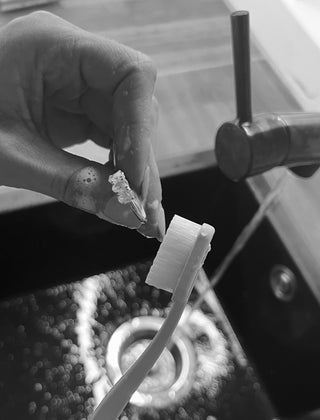
Your purchase includes 5 professional maintenance sessions and jewelry cleaning to keep your piece shining

One Free Ring-Resizing
We provide a professional ring sizing service in our showroom and offer one free ring resizing for every engagement ring to ensure the perfect fit.

Crafting Time
Typical production time after design approval is approximately 6 weeks.
How Our Amsterdam Atelier Approaches the Choice
For those who prefer an authentic, made-to-order route over a mass-market showroom, an atelier offers a completely different experience. At Charlotte de Koomen, we work with both natural and lab-grown diamonds, so the decision stays entirely with you.
Three ideas guide our approach:
- An Open Atelier Experience: Rather than picking from a fixed retail display, you are part of the process. Our studio in De Pijp turns your ideas and memories into a finished piece of handcrafted jewelry.
- Intuitive Customization: We use a Lego approach to solve the design puzzle. You choose the components – the origin of your stone, its shape, the setting, and the ring band – and we build the design around your lifestyle and preferences.
- Sustainable Craftsmanship: Responsibility sits at the core of our work. We emphasize recycled gold and working with trusted suppliers, with everything handcrafted in our combined workshop for full oversight.
The point is not that one route is right for everyone. It is that origin, shape, metal, and ethics are all yours to decide, and a down-to-earth, transparent maker makes those decisions easier.
Frequently Asked Questions
Directly from the maker.
Crafted with intention in Amsterdam.
Gerard Doustraat 70H, 1072VV Amsterdam | +31 (0)20 303 8319
You can also visit us remotely, at: charlottedekoomen.com